





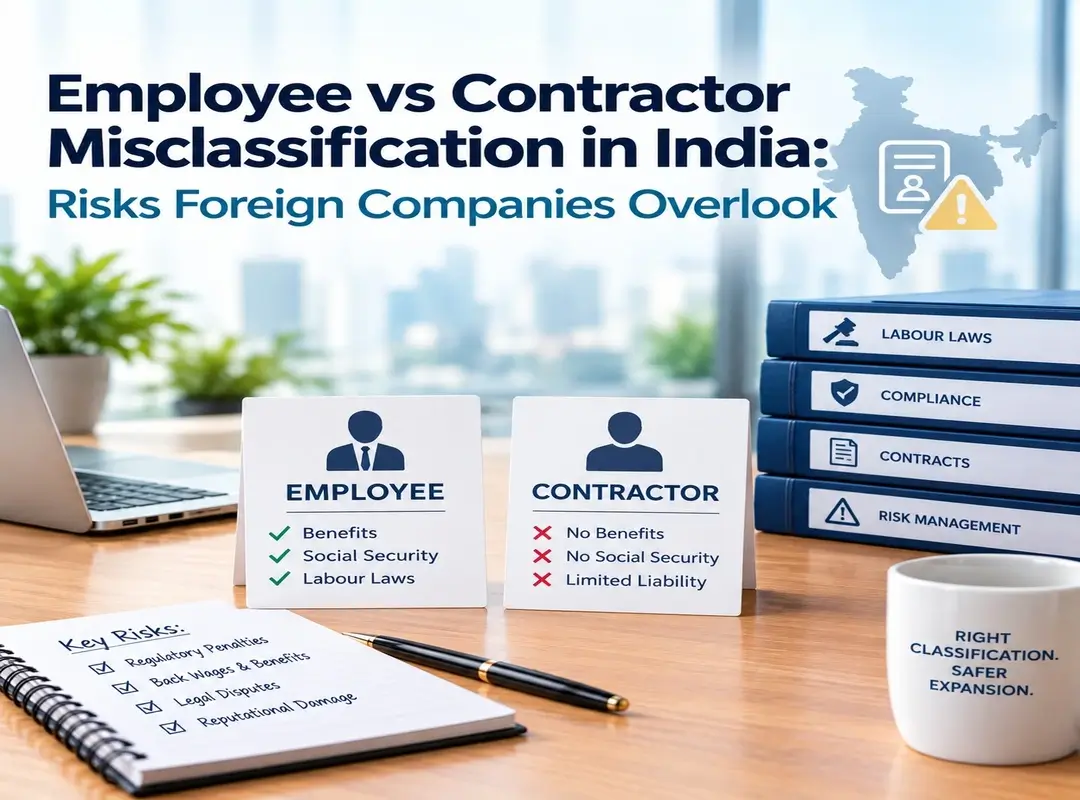
When a foreign company makes its first India hire, engaging that person as an independent contractor is often the default choice. It requires no entity, no payroll registration, and no statutory contributions, and the person can start work within days. For a genuinely independent freelancer working on a defined project, that structure is perfectly legal. The problem is that a large share of "contractor" relationships in India do not actually meet that bar, and the gap between employee vs contractor India classification is decided by how the relationship actually operates, not by what the engagement letter says.
Why India Treats This Question More Strictly Than Most Countries
Indian labour law starts from a pro-employee presumption. Where a dispute or an audit arises, the working relationship is presumed to be one of employment unless the company can demonstrate otherwise through how the work was actually structured. The Industrial Disputes Act further divides the workforce into "workmen," broadly skilled or unskilled operational staff, and other employees, but both categories receive statutory protection that a genuine contractor does not.
When a company structures what is functionally an employment relationship as a contractor arrangement purely to avoid statutory obligations, Indian authorities describe this as sham contracting. The label on the contract carries very little weight against that finding. What matters is the substance of the relationship: who directs the work, how integrated the person is into the company's operations, and how dependent they are on that single relationship for their income.
The Tests Indian Authorities Actually Apply
Classification disputes in India generally turn on four overlapping tests, and no single one is decisive on its own; authorities and courts weigh the full pattern of the relationship.
The control test asks who directs how the work gets done, not just what gets delivered. A genuine contractor decides their own method, tools, and working hours. A worker who follows a manager's daily instructions, works fixed hours set by the company, and reports progress the way an employee would looks like an employee under this test regardless of contract wording.
The integration test asks how embedded the person is in the company's operations. Someone using a company email address, appearing on internal org charts, attending the same standups as employees, and being treated as part of a team rather than an outside vendor is integrated in a way that weighs against contractor status.
The economic dependency test asks whether the person relies on this one company for the bulk of their income. A contractor with several clients and a genuinely independent business looks very different, in the eyes of Indian authorities, from someone who works exclusively for one foreign company, full time, indefinitely.
The mutuality of obligation test asks whether there is an ongoing expectation of continued work and continued payment, the hallmark of an employment relationship, as opposed to a project that has a defined start and end.
What a Genuine Contractor Looks Like, Compared to What Gets Reclassified
| Factor | Genuine Contractor | High Reclassification Risk |
|---|---|---|
| Working hours | Sets their own schedule | Fixed hours matching company working hours |
| Tools and email | Uses their own equipment and business email | Uses company laptop, company email, company Slack |
| Clients | Works with multiple clients | Works exclusively for one company, often full time |
| Payment structure | Invoices per project or deliverable | Receives a fixed monthly amount resembling salary |
| Duration | Engaged for a defined project or term | Engaged indefinitely, renewed repeatedly with no end date |
| Supervision | Delivers agreed outcomes with little day-to-day direction | Reports to a manager, attends team meetings, follows internal processes |
| Integration | Operates as an outside vendor | Appears on org charts, treated as a team member |
A relationship with even a few items from the right-hand column does not automatically fail the test, but the more of those factors that apply, the more a contractor engagement starts to resemble an employment relationship in substance, which is exactly what Indian authorities and labour tribunals evaluate.
What Misclassification Actually Costs
When a contractor is reclassified as an employee, the consequences are retrospective rather than forward-looking, which is what makes this risk more expensive than most foreign companies expect. Authorities can demand backdated Provident Fund and Employee State Insurance contributions, gratuity accrual, and TDS, typically assessed across the full duration of the relationship, often two to three years, along with interest and penalties on top of the principal amount owed. This liability is calculated per worker, so a company with several long-tenured contractors can face a combined exposure well into the tens of thousands of dollars once penalties and interest are applied.
Beyond the direct financial cost, misclassification exposure tends to surface at the worst possible moments: during a labour department audit, during a dispute when a contractor's engagement ends and they file a claim, or during financial due diligence ahead of a funding round or acquisition. A foreign investor or acquirer reviewing India operations will treat undisclosed misclassification exposure as a real liability on the balance sheet, not a formality to note and move past.
There is also a less obvious risk specific to foreign companies: a workforce that looks, in substance, like employees rather than independent contractors can strengthen an argument that the foreign parent has created a taxable presence in India, a Permanent Establishment, even without a registered entity. That is a separate and significantly larger tax exposure layered on top of the labour liability.
Read more: 7 Critical Questions to Ask Before Choosing EOR Services in India
Where This Risk Tends to Hide
Misclassification rarely starts as a deliberate decision to cut corners. It usually starts as a reasonable-seeming choice that quietly drifts over time. A company hires someone as a contractor for a three-month project, the engagement works well, and it simply continues, month after month, without anyone revisiting the structure. The person starts attending the same meetings as the core team, gets a company email address for convenience, and eventually becomes indistinguishable from an employee in every respect except the payment method and the missing statutory contributions.
The same drift happens with fixed monthly retainers that never change regardless of hours worked or deliverables completed, since a payment structure that behaves like a salary is one of the more visible signals authorities look for. Long, indefinitely renewed engagements with a single company are another common pattern, particularly for foreign companies building what is functionally a full-time India team through a series of individual contractor agreements rather than acknowledging that the underlying relationship has become employment.
Fixing This Without Losing Flexibility
The instinct many companies have when this risk becomes clear is to assume the only options are keeping the (risky) contractor structure or committing to a full India entity. There is a middle path. An Employer of Record lets a company convert what has functionally become an employment relationship into a properly structured one, with statutory contributions handled correctly from that point forward, without requiring the company to incorporate in India or manage payroll compliance directly. The day-to-day working relationship—who the person reports to, what they work on—does not need to change; what changes is who holds the legal employer obligations and files the statutory contributions correctly.
For companies that do want to keep some roles as genuine contractors, the fix is usually structural rather than cosmetic: moving toward project-based invoicing rather than fixed monthly payments, allowing the contractor to work with other clients, and reducing day-to-day direction to outcomes rather than hours and process.
Read more: How to Hire Employees in India Without a Legal Entity Using an Employer of Record
Where Vandey Global Fits
Vandey Global has been the registered legal employer for foreign companies' India teams since 2017, an ISO-certified, India-first EOR that has onboarded 600+ employees across 50+ international clients. When companies come to us with long-standing contractor relationships that have started to look like employment in substance, converting that relationship into a properly structured, compliant one under our own registered entity is one of the more common reasons foreign companies engage us in the first place. If you are unsure whether a current contractor arrangement carries this risk, our team can walk through the specific relationship against the tests described above.
Conclusion
The employee vs contractor India distinction is decided by conduct, not contract language. A worker who sets fixed hours around company processes, uses company tools, depends on one client for their income, and stays engaged indefinitely looks like an employee to Indian authorities regardless of what the engagement letter calls them, and the cost of getting that wrong is backdated, compounding, and often surfaces at the worst possible time. For any foreign company relying on contractor relationships that have lasted longer than a single defined project, this is worth a genuine audit now rather than a costly correction later.
FAQs
1. What is the main test India uses to decide employee vs contractor status?
There is no single decisive test. Authorities weigh four overlapping factors: control over how work is done, integration into the company's operations, economic dependency on a single client, and mutuality of obligation, meaning an ongoing expectation of continued work and pay.
2. Can a company avoid statutory obligations by simply calling a worker a contractor?
No. Indian authorities evaluate the substance of the working relationship rather than the label in the contract. A worker who functions as an employee in practice can be reclassified regardless of how the engagement is documented.
3. What happens financially if a contractor is reclassified as an employee?
The company typically owes backdated Provident Fund, ESI, gratuity, and TDS contributions, usually calculated across the full duration of the engagement, often two to three years, plus interest and penalties on top of the principal amount.
4. How long can someone work as a contractor before the relationship becomes risky?
There is no fixed time limit, but long, indefinitely renewed engagements with a single client, especially with fixed monthly pay and company-directed working hours, are one of the strongest signals authorities look for when assessing whether a relationship is genuinely independent.
5. What is the safest way to convert a long-term contractor into a compliant arrangement?
An Employer of Record can formalise the relationship as proper employment, handling statutory contributions correctly, without requiring the foreign company to set up its own Indian entity or change how the person's day-to-day work is managed.