





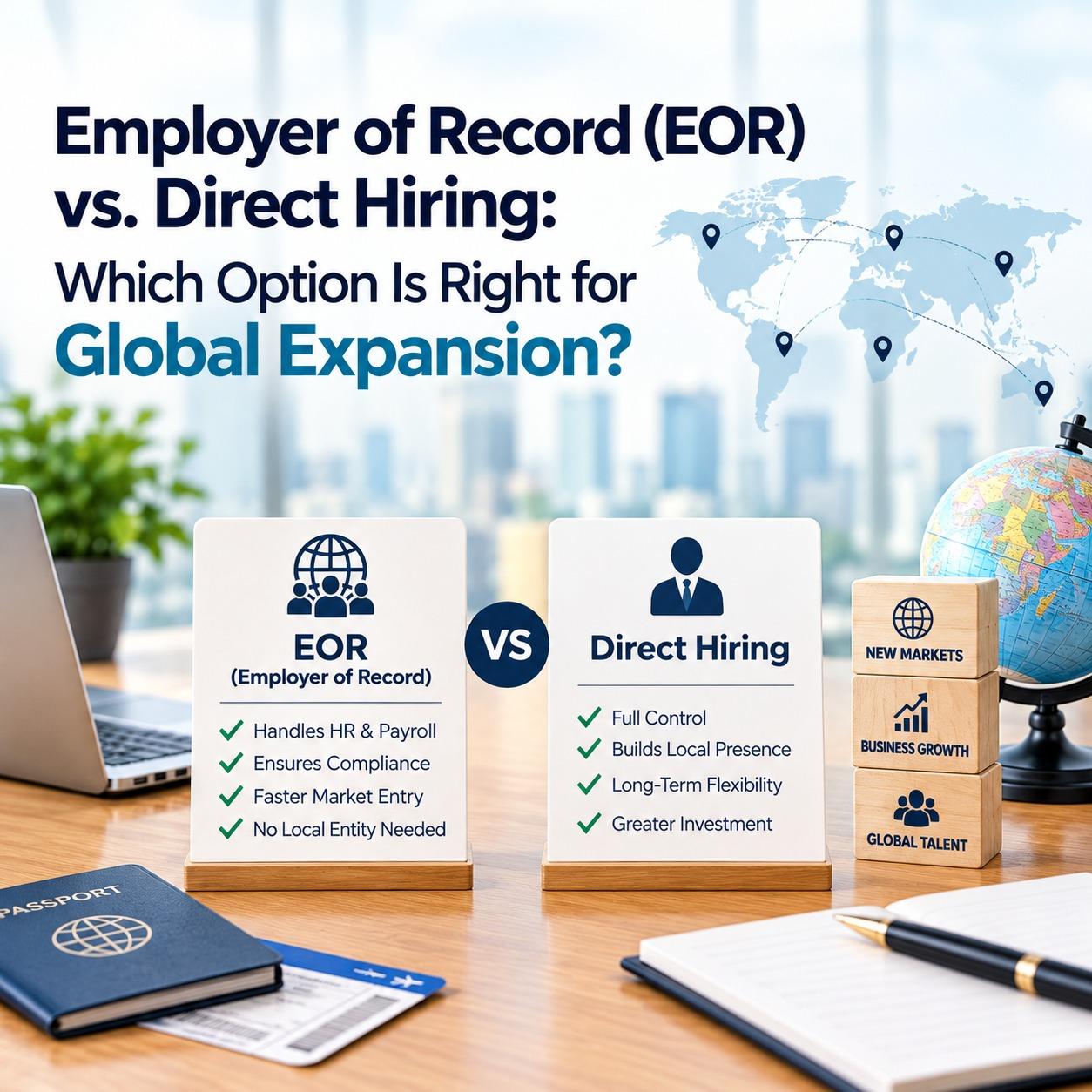
A company lands its first big client overseas, and the same question comes up almost every time: open a local entity and hire directly, or bring someone on through an Employer of Record and skip the entity altogether?
It sounds simple. It rarely stays that way. Set up an entity and you gain full control, but you also take on months of paperwork, local legal counsel, and a compliance obligation that sticks around long after you stop needing it. Choose an EOR instead and you can hire within days, though someone else technically employs your new hire on paper. Both paths deliver a working team member in a new country. They just get you there very differently, and that gap shows up in your budget, your timeline, and how much risk you want to carry.
This decision comes up constantly for companies building teams in India, where the talent runs deep but the labor law doesn’t cut anyone any slack. Choosing wrong rarely causes immediate damage. It tends to surface eighteen months later as a compliance notice, a resignation nobody predicted, or a finance team asking why hiring suddenly costs double the original budget.
What Direct Hiring Actually Involves
Direct hiring means building a real presence. You register a legal entity, whether a subsidiary, a branch office, or a joint venture, and that entity now owes local tax authorities, labor regulators, and every employment obligation the country enforces.
For a company planning to hire dozens of people in one location over several years, this route makes sense. You keep full control over hiring, firing, benefits, and culture, with no intermediary and no monthly fee stacked on top of payroll. Once you build the entity, each additional hire costs less on the margin, which is exactly why larger, longer-horizon operations tend to land here eventually.
The catch sits in everything that happens before that point. Entity setup in India can take a few months or nearly a year, depending on the state and the structure you choose. Add legal fees, local accounting, and a compliance officer to keep filings current, and the fixed costs pile up before you hire a single employee. None of that goes away once the team starts working either. Tax filings, labor law updates, and statutory audits keep demanding attention for as long as the entity exists.
What an Employer of Record Actually Does
An EOR takes a different route. The provider already runs a legal entity in your target country. Your new hire becomes their employee on paper, works exclusively for you, and takes direction from you, while the EOR manages payroll, statutory contributions, tax withholding, and local labor compliance behind the scenes.
Speed makes the biggest difference here. A hire that might take four to six months through entity setup can often start within days through an EOR, sometimes faster once documentation clears. You skip the capital outlay for entity formation and the internal compliance buildout, because the EOR absorbs that risk as part of the service.
That protection matters more than it looks on paper. A misclassified worker or a termination handled the wrong way under local law can trigger real financial penalties, back-pay claims, or worse. Routing that risk through a provider who handles it daily, across many clients, usually protects a company hiring somewhere for the first time far better than handling it alone.
The trade-off comes as an ongoing per-employee fee stacked on top of salary, plus a layer of separation between the company and the employee that some founders notice even when it doesn’t change the working relationship at all.
Making the Call
Neither model wins outright. A company hiring its first employee abroad, moving fast on an opportunity, or still unsure how long-term the commitment runs usually finds that an EOR gives it room to move without locking up capital it isn’t ready to spend. A company with a clear, large-scale hiring plan and the patience to build real infrastructure often finds direct hiring pays off over a longer stretch.
Businesses weighing India specifically should run the real numbers before choosing. Vandey’s cost estimator shows exactly what an India hire costs through the EOR model. Vandey Global’s employment services handle that EOR relationship end to end, and Vandey’s market entry support helps you decide whether India, or any new market, makes sense before you commit to a single hire.